
Study: Geek Bars Have Half the Nicotine Advertised
A peer-reviewed analysis found that several Geek Bar samples contained far less nicotine than their 5% labels suggested — but the findings come with important caveats.
There’s an uncomfortable question hanging over one of the most popular disposable vape brands in the United States: Do Geek Bars actually contain as much nicotine as the label says?
A recent peer-reviewed study published in ACS Omega suggests that at least some of them may not. Researchers analyzed 25 disposable vapes from four well-known brands — Flum Pebble, Elf Bar, Esco Bars and Geek Bar — and compared the nicotine content of the e-liquid against the nicotine strength printed on the packaging.
The most striking result involved Geek Bar. All five Geek Bar products tested were labeled as containing 50 mg/ml of nicotine, equivalent to 5%. None of the five samples actually measured at 50 mg/ml.
In fact, the average measured nicotine strength across the five Geek Bar samples was about 27.9 mg/ml — a little over half of the advertised amount.
That doesn’t prove that every Geek Bar on the market is mislabeled or that Geek Bar intentionally misrepresented anything. It also doesn’t prove that the tested devices were authentic products, which is an important point given the brand’s well-documented supply chain issues.
Still, the results are notable because Geek Bar is one of the dominant brands in the modern disposable vape market. If the findings are representative of real products being sold to consumers, they raise serious questions about how reliable disposable vape labels really are.
What Did the Study Find?
The researchers tested the e-liquid inside the devices rather than relying on label claims. They measured nicotine concentration, nicotine type, organic acids used to create nicotine salts, flavoring chemicals, synthetic coolants and aerosol emissions.
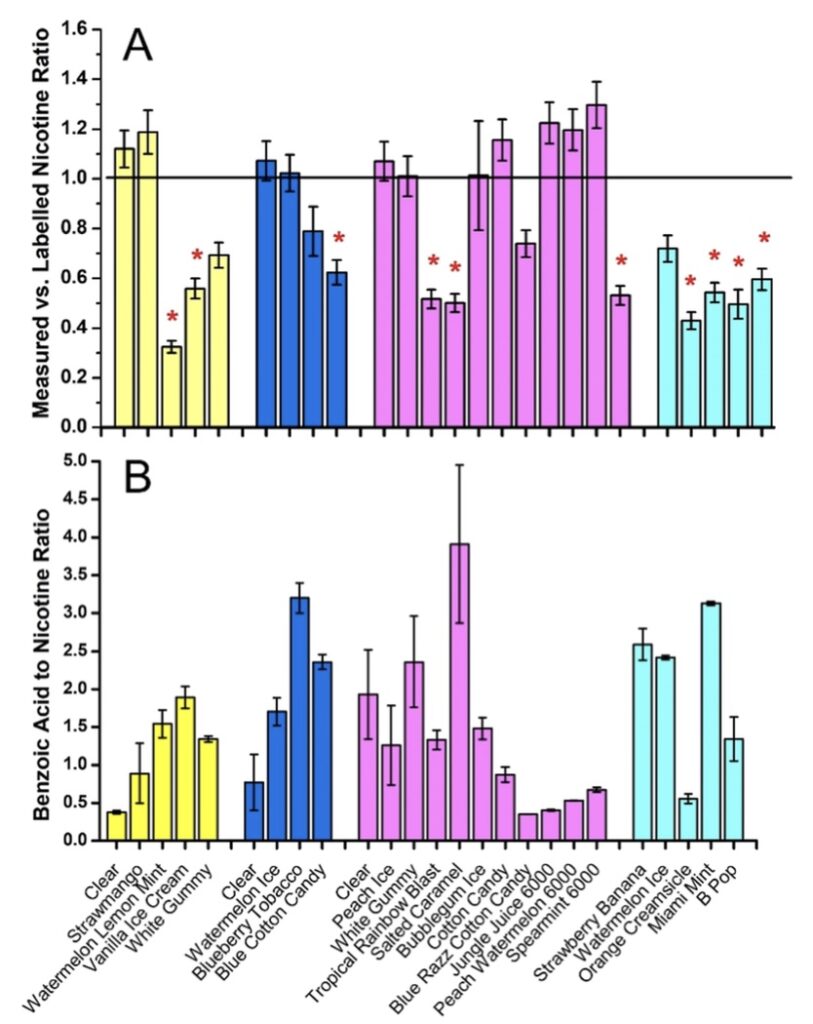
For nicotine labeling, the headline finding was this: 10 of the 25 disposable vapes tested contained significantly less nicotine than their labels claimed.
Geek Bar stood out because every Geek Bar sample tested was below the advertised 50 mg/ml strength.
| Geek Bar Flavor Tested | Labeled Nicotine Strength | Measured Nicotine Strength | Approximate Share of Label Claim |
|---|---|---|---|
| Strawberry Banana | 50 mg/ml | 36.0 mg/ml | 72% |
| Watermelon Ice | 50 mg/ml | 21.5 mg/ml | 43% |
| Orange Creamsicle | 50 mg/ml | 27.2 mg/ml | 54% |
| Miami Mint | 50 mg/ml | 24.8 mg/ml | 50% |
| B Pop | 50 mg/ml | 29.8 mg/ml | 60% |
Four of the five Geek Bar samples were significantly lower than the labeled strength according to the study’s statistical analysis. The fifth, Strawberry Banana, was still well below the 50 mg/ml label claim, although not flagged in the same way after accounting for the study’s uncertainty range.
The researchers summarized the Geek Bar finding directly: every Geek Bar product tested was “roughly half” of its labeled nicotine content.
This Is Not Just a Geek Bar Problem
Although Geek Bar produced the most eye-catching result, the study did not find perfect label accuracy across the rest of the disposable vape market either.
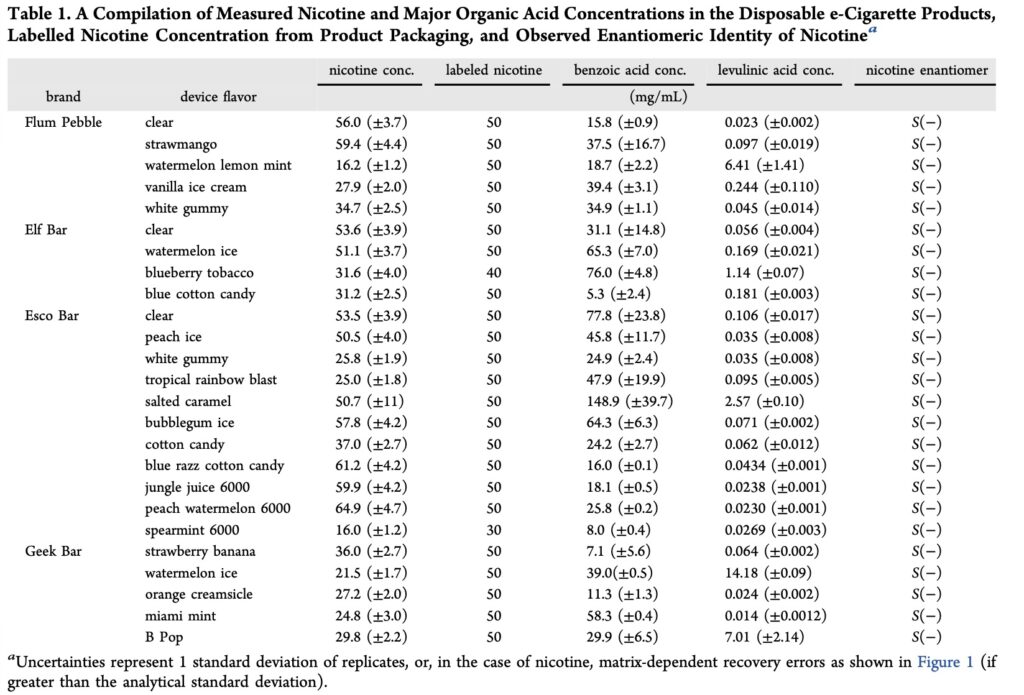
Other brands also had devices that measured below their labeled nicotine strength. The study found that all four brands tested — Flum Pebble, Elf Bar, Esco Bars and Geek Bar — had multiple products with lower nicotine concentrations than advertised. In other words, the study casts doubt on labeling accuracy for all disposable vapes.
That fits with a broader pattern we’ve seen in the disposable market. Puff counts have already become increasingly disconnected from reality, with many brands advertising numbers that appear to be based more on marketing than on real-world use. Nicotine strength may be another area where consumers can’t always assume the label tells the full story.
Does Lower Nicotine Mean the Vape Is Safer?
Not necessarily.
It’s easy to look at a lower nicotine measurement and assume that it must be good news. Nicotine is addictive, so less nicotine sounds better than more nicotine.
The problem is that consumers don’t use vapes in a laboratory. People often adjust their usage based on how satisfying a product feels. If a vape contains less nicotine than expected, some users may simply puff more often, take longer puffs or replace the device sooner.
The study’s authors noted this possibility, pointing to prior research suggesting that lower-nicotine products can lead users to purchase more nicotine products.
So, a lower-than-advertised nicotine strength doesn’t automatically mean a lower overall exposure. It may simply change how the product is used. It could also be more profitable for the manufacturer.
The Study Found Other Concerns Beyond Nicotine
Nicotine accuracy was only one part of the study. The researchers also looked at what else was in the e-liquid and aerosol.
A few findings stood out.
All of the devices tested contained nicotine in the S-(-)-nicotine form. That’s notable because previous research has found some disposable vapes containing mixtures of nicotine enantiomers, including R-(+)-nicotine, whose safety profile is less well understood. In this study, that particular issue did not appear.
The researchers also found that all tested devices used benzoic acid to form nicotine salts. Benzoic acid is commonly used in nicotine salt e-liquids because it reduces harshness, allowing higher nicotine concentrations to feel smoother. However, the amount of benzoic acid varied widely from product to product.
The study also found high levels of the synthetic coolant WS-23 in every product tested. WS-23 is used to create a cooling sensation without necessarily adding a strong mint flavor. The researchers found it at levels ranging from 1% to 7% of the e-liquid.
Several common flavoring chemicals were also detected across many devices, including vanillin, ethyl maltol, triacetin and (3Z)-3-hexen-1-ol. According to the study, concentrations of several additives exceeded thresholds associated with toxic effects in prior research.
The aerosol results varied by brand and device. Esco Bars produced the highest levels of harmful or potentially harmful carbonyl compounds in the study, while Flum Pebble produced the lowest. Geek Bar was not the worst brand in that part of the analysis, although the researchers did note variability between Geek Bar flavors.
The Big Limitation: Only Five Geek Bars Were Tested
The biggest limitation of the study is sample size.
Only five Geek Bar flavors were tested:
- Strawberry Banana
- Watermelon Ice
- Orange Creamsicle
- Miami Mint
- B Pop
That is not enough to make a sweeping claim about every Geek Bar product sold in the United States. Geek Bar has released many products and flavors, and manufacturing can change over time.
The study also used 2-3 replicates per device flavor depending on product availability. That’s useful for laboratory consistency, but it still doesn’t tell us how much variation exists across different production runs, factories, distributors or retailers.
The correct conclusion is not “all Geek Bars have half the nicotine advertised.” The better conclusion is that the Geek Bar samples tested in this study measured substantially below their labeled nicotine strength, and the finding deserves further investigation.
Another Limitation: Were the Geek Bars Authentic?
There’s another important caveat: we can’t independently verify that the samples were authentic Geek Bars.
The study states that the products were purchased from various online retailers in 2024. It does not appear to describe a separate authentication process proving that every device came directly from the manufacturer or an authorized supply chain.
That matters because Geek Bar is one of the most counterfeited vape brands on the market. We’ve covered this issue in our guide to whether Geek Bars are banned and why they can be hard to find. When products become difficult to source through normal channels, counterfeit and grey-market products become more likely to appear.
If any of the tested products were counterfeit, the results would still matter for consumers because people may be buying those products in the real world. However, counterfeit samples would tell us less about Geek Bar’s own manufacturing quality.
That’s why the authenticity issue is not a minor footnote. It is central to how the study should be interpreted.
What Should Consumers Take From This?
The practical takeaway is simple: don’t assume that the numbers printed on a disposable vape package are perfectly accurate.
That applies to puff counts, and this study suggests that it may also apply to nicotine strength. A device labeled as 5% nicotine may not necessarily contain exactly 50 mg/ml of nicotine. It may contain less. In some cases, it could contain much less.
For consumers, that means a few things.
Buy from reputable vape retailers rather than random marketplace sellers or non-specialist shops. This is especially important for heavily counterfeited brands like Geek Bar.
Be cautious when switching between disposable vape brands or flavors. Two devices with the same printed nicotine strength may not feel the same because the actual nicotine content, aerosol output and formulation can differ.
Don’t use puff count or nicotine percentage as your only basis for comparing products. Disposable vape marketing has become increasingly aggressive, and some claims deserve skepticism.
Finally, if a vape feels unusually weak, unusually harsh or simply different from what you expect, don’t assume the issue is your tolerance. The product itself may not match the label, or it may not be authentic.
The Bottom Line
Did the Geek Bars in this study have half the nicotine advertised?
In several cases, yes. The five Geek Bar samples tested were all labeled as 50 mg/ml, but the measured nicotine concentrations ranged from 21.5 to 36.0 mg/ml. On average, they measured a little over half of the labeled strength.
That’s a significant finding, but it should be interpreted carefully. The sample size was small, only a handful of flavors were tested and the study does not prove that the devices were authentic. It also doesn’t establish that Geek Bar is uniquely problematic, because other disposable vape brands in the study showed nicotine inconsistencies as well.
The more important point is broader: disposable vape labels may not be as reliable as consumers assume. In a market already filled with inflated puff counts, inconsistent availability and counterfeit products, nicotine accuracy is another area where more testing and transparency are clearly needed.
Jason Artman is the founder of eCigOne.com, where he helps vape and alternative nicotine brands grow through SEO and digital marketing. Jason's work has been featured in major media and cited in peer-reviewed research. He has helped to drive growth for well-known vape brands such as JUUL, NJOY, VaporFi, South Beach Smoke and V2 Cigs.
0 Comments