
Are Geek Bars Banned? State-by-State Laws and Availability in 2026
Are Geek Bars banned? In some states, they effectively are – but the answer isn’t as simple as a blanket ban. Geek Bars aren’t banned by name at the federal level. However, the fact that they lack FDA authorization means that they’re potentially subject to federal and state enforcement actions. PMTA registry laws and flavor bans in some states and cities may also mean that Geek Bars are effectively banned where you live.
Are Geek Bars banned in your state, or are they just hard to find because of a supply shortage? Use our interactive map to check for active bans around the country.
Vape laws can change quickly. This guide reflects the best information available at the time of publication. Last update: March 20, 2026.
Are Geek Bars Banned? At a Glance
Federally:
Not banned, but unauthorized
States:
Some states have banned all vapes lacking FDA authorization
Flavor Bans:
Some states have banned most vape flavors
Availability:
Supply chain issues have not fully disappeared in 2026
Are Geek Bars Banned in My State? Interactive Map
Click, tap or hover over the map to see the details. Scroll below the map to see the raw data and read important notes.
Notes:
- A PMTA registry law means that no vape can be sold legally unless the FDA has authorized it for marketing. No Geek Bar product has been authorized by the FDA, so a PMTA registry law effectively bans Geek Bars in that state. The PMTA process is explained in greater detail below.
- A flavor ban means that the state has banned all vapes with characterizing flavors other than tobacco and sometimes mint/menthol. In states with flavor bans, Geek Bars are only available in the flavors that are allowed.
- Due to tribal sovereignty, Geek Bars may still be available on tribal lands in states where Geek Bars are otherwise banned.
- Some states do not have PMTA registry laws but have nevertheless taken action against vape shops selling vapes not authorized by the FDA. Alaska and Hawaii are two examples.
Raw Data on State Geek Bar Bans (Click to Expand)
| State | Geek Bar Availability | PMTA Registry Law? | Flavor Ban? | Notes | Reference |
|---|---|---|---|---|---|
| Alabama | Available | No | No | A pending PMTA registry law is on hold in Alabama pending the outcome of a lawsuit as of late 2025. | https://www.al.com/news/2025/10/lawsuit-puts-a-hold-on-alabamas-sweeping-vape-regulations.html |
| Alaska | Available | No | No | ||
| Arizona | Available | No | No | Arizona SB1367 would establish a PMTA registry requirement in the state, but the bill has not passed as of March 2026. | https://apps.azleg.gov/BillStatus/BillOverview/84920 |
| Arkansas | Banned | Yes | No | https://arkleg.state.ar.us/Home/FTPDocument?path=%2FACTS%2F2025R%2FPublic%2FACT590.pdf | |
| California | Banned | Yes | Yes | California's Unflavored Tobacco List is functionally similar to a PMTA registry law in that any product not on the list is illegal in the state. | https://utl.doj.ca.gov/ |
| Colorado | Available | No | No* | * Flavored vapes are banned in the City and County of Denver. | https://www.denvergov.org/Government/Agencies-Departments-Offices/Agencies-Departments-Offices-Directory/Public-Health-Environment/Community-Behavioral-Health/Tobacco-Program/Flavored-Tobacco/Ban-on-Retail-Sale-of-Flavored-Tobacco-Products-Frequently-Asked-Questions |
| Connecticut | Available | No | No | ||
| District of Columbia | Limited | No | Yes | https://dlcp.dc.gov/page/flavored-tobacco-and-electronic-smoking-device-products-prohibition | |
| Delaware | Available | No | No | Delaware SB77 would establish a PMTA registry requirement in the state, but the bill has not passed as of March 2026. | https://legis.delaware.gov/BillDetail?legislationId=141979 |
| Florida | Limited | No | No | Florida maintains a directory of "nicotine dispensing devices that are attractive to minors," and all vapes on the list -- which includes many Geek Bar products -- are banned. | https://www.myfloridalegal.com/NDDDirectory |
| Georgia | Available | No | No | Georgia HB577 would establish a PMTA registry requirement in the state, but the bill has not passed as of March 2026. | https://legiscan.com/GA/bill/HB577/2025 |
| Hawaii | Available | No | No | Hawaii HB1573 would establish a PMTA registry requirement in the state, but the bill has not passed as of March 2026. | https://legiscan.com/HI/text/HB1573/id/3322687 |
| Idaho | Available | No | No | ||
| Illinois | Available | No | No* | * Flavored vapes are banned in Cook County, which includes Chicago and Evanston. | https://cookcountypublichealth.org/chronic-diseases/flavored-nicotine/ |
| Indiana | Available | No | No | ||
| Iowa | Available | No | No | A pending PMTA registry law is on hold in Iowa pending the outcome of a lawsuit as of early 2026. | https://nicotineinsider.com/2026/01/19/eighth-circuit-questions-iowa-vape-registry/ |
| Kansas | Available | No | No | ||
| Kentucky | Banned | Yes | No | https://www.publichealthlawcenter.org/sites/default/files/inline-files/KY-Registry-SB-344.pdf | |
| Louisiana | Banned | Yes | No | https://www.legis.la.gov/legis/ViewDocument.aspx?d=1332753 | |
| Maine | Available | No | No* | * Flavored vapes are banned in Portland, South Portland, Brunswick, Bar Harbor and Bangor. | https://truthinitiative.org/research-resources/smoking-region/tobacco-use-maine-2023 |
| Maryland | Limited | No | Yes | https://www.publichealthlawcenter.org/resources/us-e-cigarette-regulations-50-state-review/md | |
| Massachusetts | Limited | No | Yes | https://www.mass.gov/guides/2019-tobacco-control-law | |
| Michigan | Available | No | No | ||
| Minnesota | Available | No | No | ||
| Mississippi | Banned | Yes | No | https://legiscan.com/MS/text/HB916/id/3087699 | |
| Missouri | Available | No | No | ||
| Montana | Available | No | No* | * Flavored vapes are banned in Missoula. | https://www.ci.missoula.mt.us/DocumentCenter/View/54901/Ordinance-3672 |
| Nebraska | Banned | Yes | No | https://revenue.nebraska.gov/about/frequently-asked-questions/tax-on-consumable-material-faqs | |
| Nevada | Available | No | No | ||
| New Hampshire | Available | No | No | ||
| New Jersey | Limited | No | Yes | https://law.justia.com/codes/new-jersey/title-2a/section-2a-170-51-12/ | |
| New Mexico | Available | No | No | ||
| New York | Limited | No* | Yes | In 2026, New York Governor Kathy Hochul initiated a proposal that would result in the creation of a PMTA registry if enacted. | https://www.news10.com/capitol/ny-vape-tax-2027/ |
| North Carolina | Banned | Yes | No | https://www.ncdor.gov/taxes-forms/other-taxes-and-fees/vapor-product-and-consumable-product-certification-directory | |
| North Dakota | Available | No | No | ||
| Ohio | Available | No | No* | As of March 2026, the Ohio Supreme Court is hearing arguments over the state's ability to override local flavor bans. | https://signalohio.org/ohio-ags-flavored-vape-crackdown-goes-to-state-supreme-court/ |
| Oklahoma | Banned | Yes | No | https://oklahoma.gov/able-commission/enforcement/tobacco-and-vape-information.html | |
| Oregon | Available | No | No* | * Flavored vapes are banned in Multnomah and Washington Counties. | https://multco.us/news/court-issues-opinion-flavored-tobacco-sales-ban |
| Pennsylvania | Banned | Yes | No | https://www.attorneygeneral.gov/ends/ | |
| Rhode Island | Limited | No | Yes | https://tax.ri.gov/sites/g/files/xkgbur541/files/2024-08/Notice_2024_04_ENDS_flavor_ban.pdf | |
| South Carolina | Banned | Yes | No | https://www.scstatehouse.gov/sess126_2025-2026/bills/287.htm | |
| South Dakota | Available | No | No | ||
| Tennessee | Banned | Yes | No | https://www.tn.gov/content/dam/tn/revenue/documents/notices/tobacco/25-06tob.pdf | |
| Texas | Limited | No* | No | Texas SB2024, which passed in 2025, bans vapes wholly or partially manufactured in China or any other country designated as a foreign adversary. | https://legiscan.com/TX/bill/SB2024/2025 |
| Utah | Banned | Yes | Yes | https://tax.utah.gov/business/other-taxes/tobacco/e-cigarette/ | |
| Vermont | Available | No | No | Vermont S0018 would have enacted a flavor ban in the state but was vetoed. A vote to override the veto failed. | https://legiscan.com/VT/bill/S0018/2023 |
| Virginia | Banned | Yes | No | https://law.lis.virginia.gov/vacodeupdates/title59.1/section59.1-293.20/ | |
| Washington | Available | No | No | As of March 2026, Washington has pending legislation that would create a PMTA registry requirement (HB1534) and ban flavored vapes (HB1203/SB5183). | https://legiscan.com/WA/bill/HB1534/2025 |
| West Virginia | Available | No | No | West Virginia HB5437 has been passed by both houses and will create a PMTA registry requirement if signed into law, which has not yet happened as of March 19, 2026. | https://legiscan.com/WV/bill/HB5437/2026 |
| Wisconsin | Banned | Yes | No | https://docs.legis.wisconsin.gov/misc/lc/issue_briefs/2025/alcohol_beverages_and_cannabis/ib_vaping_retail_licensing_registry_tk_2025_09_19 | |
Has the FDA Banned Geek Bars?
The FDA has not explicitly banned Geek Bars by name. However, it has not granted a marketing order to any Geek Bar product. Any vaping product that lacks FDA marketing authorization is unauthorized for sale under federal law and may be subject to enforcement action at the FDA’s discretion.
FDA Regulations and PMTA Registry Laws in Plain English
Why can’t you just buy Geek Bars anywhere? Here’s a short explanation of the FDA’s vape regulations, how they apply to Geek Bars and why you can’t buy a Geek Bar in a “PMTA registry” state.
- According to the Family Smoking Prevention and Tobacco Control Act, all new tobacco products must receive marketing orders from the FDA before they can legally be sold.
- The FDA deemed all vaping products to be “tobacco products” in 2016.
- To receive a marketing order from the FDA, the product’s manufacturer must submit a Premarket Tobacco Product Application (PMTA) demonstrating that the product is “appropriate for the protection of public health.”
- The FDA has received many millions of PMTAs from vape brands and has either denied or refused to review almost all of them.
Any vaping product that hasn’t been granted a marketing order is unauthorized for legal sale and is subject to enforcement action at the FDA’s discretion.
A PMTA registry law extends that by establishing a state-level monitoring system prohibiting all vapes that haven’t been granted FDA marketing orders.
As of March 2026, the only vapes that have been granted marketing orders are the Glas G2, JUUL, Logic Power, Logic Pro, Logic VapeLeaf, NJOY Ace, NJOY Daily, Vuse Alto, Vuse Ciro and Vuse Vibe. These are the only vapes that aren’t banned in PMTA registry states.
Why Did Geek Bars Feel Banned in 2025?
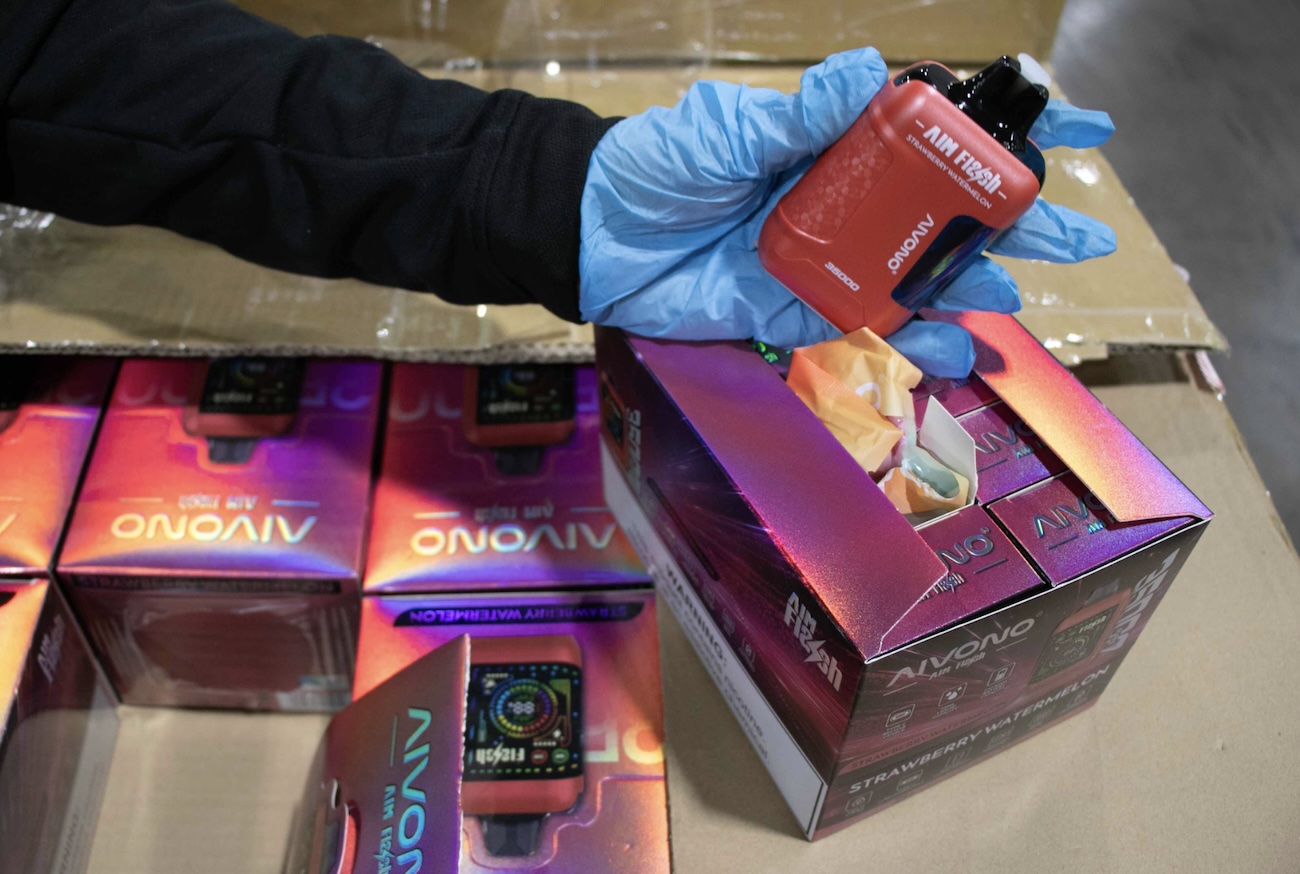
A gloved hand holds a vape seized at the border by U.S. Customs and Border Protection.
In mid-2025, there was a severe Geek Bar shortage throughout the United States. Local vape shops throughout the country were affected. At one point, even the biggest distributors and online vape shops had virtually no Geek Bars available. So, why did it happen?
Increased Tariffs
Most vaping products are made in China, and Chinese imports were subject to increased tariffs beginning in 2025. Between the high tariffs and confusion over exactly what rate would apply at the time of importation, many vape distributors scaled back their orders. In an effort to maintain stock levels, some distributors restricted how many Geek Bar products retailers could purchase. Geek Vape – the manufacturer of Geek Bar – responded by temporarily reducing Geek Bar production volumes.
Increased Customs Enforcement
On January 3, 2025, the FDA updated its Import Alerts to state that all shipments of unauthorized vapes should be detained upon reaching U.S. borders. The federal government had already taken action in the past to seize imports of unapproved vapes, and the updated Import Alert reflected a mandate to increase enforcement even further.
Prior to the increased tariffs, many vape shipments from China were intentionally given vague or misleading labels like “Electronics” or even “Shoes,” allowing them to be imported successfully. Between the tariffs and the Import Alerts, though, all shipments from China were scrutinized in 2025. The scrutiny resulted in an unprecedented level of seizures.
- In May 2024, the U.S. received nearly 1,200 shipments from China labeled as vapes.
- In May 2025, the number dwindled to just 71.
What’s Changed About the Geek Bar Shortage in 2026?
The situation was difficult for Geek Bar fans in 2025, but Geek Bars are back in many vape shops in 2026. The legal situation hasn’t changed, so what’s different?
Shift to Indonesia
Online reports suggest that at least some Geek Bars are now being made in Indonesia, which could potentially reduce the scrutiny on incoming shipments.
Changing Consumer Interest
When a preferred brand isn’t available, vapers will simply choose an alternative. While Geek Bar is still the most popular vape brand in the U.S. by search volume, its popularity has decreased significantly since the height of the shortage in 2025. According to search data provider Ahrefs, the monthly search volume for “Geek Bar” decreased from 479,000 in July 2025 to 319,000 as of March 2026. The change in search volume suggests that many people switched brands and didn’t come back.
Higher Prices
Although Geek Bars are now available in many vape shops again, the prices are often much higher than they were. By late 2025, major online retailers were charging as much as $25 for the Geek Bar Pulse, which averaged around $15 before the shortage. The increased prices quelled demand and reduced the need for frequent restocking. Prices have begun to normalize somewhat as of March 2026, although they haven’t returned to their previous levels.
What to Do if You Can’t Buy Geek Bars
The Geek Bar shortage has mostly subsided in 2026, but the supply chain for the vaping industry isn’t always reliable – so the situation could change at any time. What should you do if Geek Bars become hard to find again?
- Be wary of non-specialized sellers. Geek Bar is one of the most heavily counterfeited vape brands, and you’re less likely to find fake Geek Bars at a vape shop.
- Try related brands. The Digiflavor and Raz Vape brands are both affiliated with Geek Vape. If those brands are still available where you are, you’ll have a chance to enjoy similar flavors and technologies.
- Try vapes with similar flavor names. Some brands have very good clones of Geek Bar’s most popular flavors.
- Switch to a refillable vape. Although the FDA has not authorized any e-liquid for sale, bottled vape juice is much more widely available than disposable vapes with perceived youth appeal.
Geek Bar Fan?
Jason Artman is the founder of eCigOne.com, where he helps vape and alternative nicotine brands grow through SEO and digital marketing. Jason's work has been featured in major media and cited in peer-reviewed research. He has helped to drive growth for well-known vape brands such as JUUL, NJOY, VaporFi, South Beach Smoke and V2 Cigs.
Wouldn’t it be better to go legal with Vuse or switch to legal modern oral like Velo plus?
Hi David,
Unfortunately, most nicotine pouch brands like Velo exist in the same legal gray area as Geek Bar. Despite being widely available, Velo isn’t “legal” because it has no marketing order from the FDA.
ZYN is the only nicotine pouch brand that has received a marketing order from the FDA, which is probably a big part of why Philip Morris bought Swedish Match (although ZYN hadn’t yet received FDA approval at the time of the purchase).
As for Vuse and the other vape brands that have FDA approval, a lot of people would say that they simply don’t taste very good. In a survey of over 69,000 vapers published in Harm Reduction Journal in 2023, just 2.1 percent reported tobacco as their most-used flavor. That’s pretty much all that’s legally available from Vuse, NJOY and Logic — tobacco flavors and a few menthol flavors that are really more like menthol-tobacco.
Faced with the choice of using those vapes or smoking, many would just go back to smoking.
Didn’t disposables get a specific ‘carve-out’ during COVID, exempting them from PMTA rules? I remember that being a big thing a few years back.
No. It’s a pretty convoluted story, but it basically comes down to this.
1. In early 2020, the Trump administration implemented a ban on pre-filled vape pods in flavors other than tobacco and menthol. This was done primarily because of JUUL, which was being purchased in large numbers by teens. The hope was that teens wouldn’t want to buy the product anymore if fruity flavors were no longer available. Bottled e-liquids were exempt from the flavor ban because teens have never really bought those. The flavored pod ban didn’t override the existing PMTA requirements.
2. There’s great demand for pre-filled vaping devices in appealing flavors, though, so manufacturers shifted to disposables instead. There wasn’t a carve-out for disposable vapes in the flavored pod ban; disposables simply weren’t mentioned at all because nobody used them at the time. The PMTA requirements still applied to those devices, but the flavored pod ban didn’t.
3. When the FDA began to crack down on disposables, the manufacturers switched to synthetic nicotine to evade FDA regulation. At the time, the FDA didn’t have the authority to regulate products containing synthetic nicotine.
4. The federal government’s omnibus budget bill for 2022 included a clause granting the FDA authority over synthetic nicotine products. It’s common for legislators to sneak potentially contentious items into omnibus bills because it allows those items to pass without debate. Omnibus bills have to pass, or the federal government shuts down. Some congresspeople don’t even read omnibus bills before voting on them. Neither party actually supports vaping, though, so giving the FDA authority over synthetic nicotine was probably always going to happen. Putting it into an omnibus bill just made it immediate.
That’s where we are now. All vaping products are subject to the FDA’s PMTA requirements, and almost all vaping products are “illegal” in the United States because virtually none of them have FDA marketing orders. All of the vaping products that DO have FDA marketing orders are produced by Big Tobacco companies. Meanwhile, we’re all relearning why prohibition doesn’t work.