
The Replacement-Pod Model: A UK Retailer’s Lessons After the Single-Use Ban
By Reza. Checked on 12 November 2026.
At a glance
- The UK single-use vape ban began on 1 June 2025. Rechargeability alone does not meet the reusable-device requirements.
- A prefilled pod can be a replacement part for a reusable kit. The coil can be replaced inside that pod.
- Plan the kit range and the replacement range together, then manage stock by exact model and flavour.
- Explain what stays, what is replaced and whether the customer ever adds bottled liquid.
- Check product legality separately from stock availability. UK specifications do not establish permission to sell a product in the United States.
Running a UK online vape shop means answering two different questions: what comes with the device, and what fits it afterwards? At Vape Forest, our Hayati Pro Ultra Plus 25000 kit and its replacement pack have separate catalogue records. Our reference guides also distinguish charging the battery from replacing the liquid-containing parts. That separation is the starting point for this article.
The practical lesson for another shop is to treat a rechargeable kit as a product with an ongoing parts requirement. The initial transaction supplies the body; subsequent transactions can supply the consumables while that body remains functional. Stock planning, product descriptions and fault handling all need to reflect the difference. The example here illustrates that retail task, rather than making a performance comparison between brands.
What the UK changed, and why it matters elsewhere
From 1 June 2025, businesses across the UK could no longer sell or supply single-use vapes, including versions without nicotine. The prohibition covers online and physical retail. England’s regulations define a single-use vape by its ability to be reused, refilled and recharged, with requirements covering replacement coils. A charging socket on its own does not settle the question. 1 2
The detail that matters to a shop is the definition of refilling. It includes replacing a prefilled container, not just pouring liquid into an open tank. A coil can also be replaced as part of a pod. Government guidance says the replacement items should be separately available, and businesses must be able to demonstrate that customers can obtain them. 1
For a retailer, that creates a connection between the original kit and the parts stocked afterwards. Before adding a device to a range, I would ask the supplier to identify its replacement item, show the assembly instructions and explain how ongoing supply will work. A catalogue name or a photograph of a charging port is insufficient evidence.
The transferable lesson is about managing dependencies. A shop elsewhere may operate under different product rules, but it can still ask whether the consumable will be available after the kit leaves the shelf. Do the staff know its exact name? Can the customer recognise it? What happens when that model is discontinued? Those questions belong in the buying decision, before a shop has working devices in customers’ hands and no matching parts to offer.
How a prefilled pod system actually works
The Hayati Pro Ultra Plus 25000 is a useful example because its components have distinct roles. Our kit listing describes a rechargeable body, two prefilled tanks and a mouthpiece that turns 180 degrees to select a side. It specifies USB-C charging. The body supplies power; charging it does not replenish liquid or replace a worn coil.
The separately supplied Hayati Pro Ultra Plus 25000 replacement pods are listed as a pack containing one 2 ml prefilled pod with a built-in dual mesh coil, two 10 ml refill containers and a user manual. The containers feed liquid into the pod. There is no battery in that pack, so it cannot operate independently. These are the replacement-pack contents, not a claim that every starter kit has identical contents.
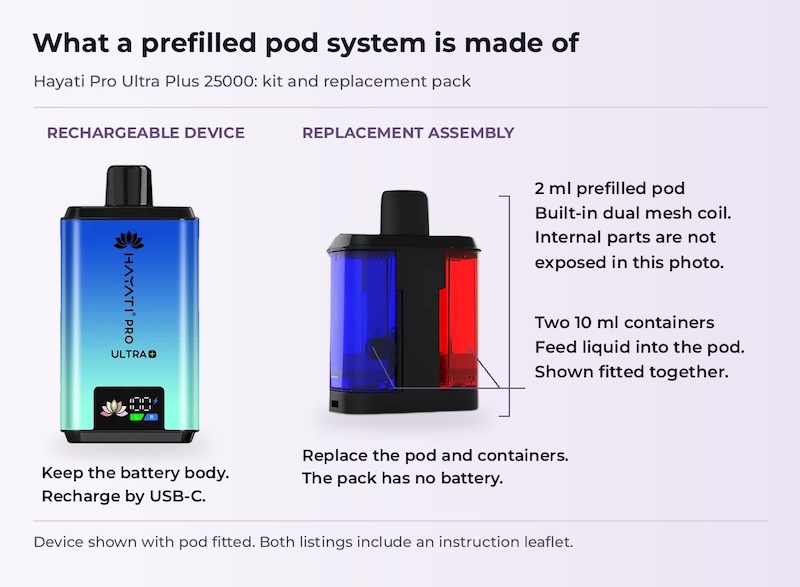
The kit listing includes a device with two prefilled tanks and a leaflet. The separate replacement pack includes a 2 ml pod with its coil, two 10 ml containers and a manual; the coil is internal and is not exposed in this photograph.
This is where the word refill needs care. Here it means fitting the compatible prefilled assembly. It does not mean opening the sealed pod and pouring a chosen bottled e-liquid into it. Our replacement guide makes that distinction explicitly and directs the owner to the instructions supplied with the exact pack.
Compatibility needs the same precision. Pro Ultra Plus 25K and Pro Ultra Plus 25000 identify the same model in our catalogue. Its replacement pack is not listed for the original Pro Ultra 15000 or the Pro Max Plus. A shared brand, similar casing or familiar flavour name does not establish a fit.
Nor does the number in the model name provide a stock-planning unit: the manufacturer rates it at up to 25,000 puffs; the real count depends on draw length and usage. A shop should not convert that into a fixed interval between purchases. Track replacement packs as actual units, and record their component contents separately from any puff rating.
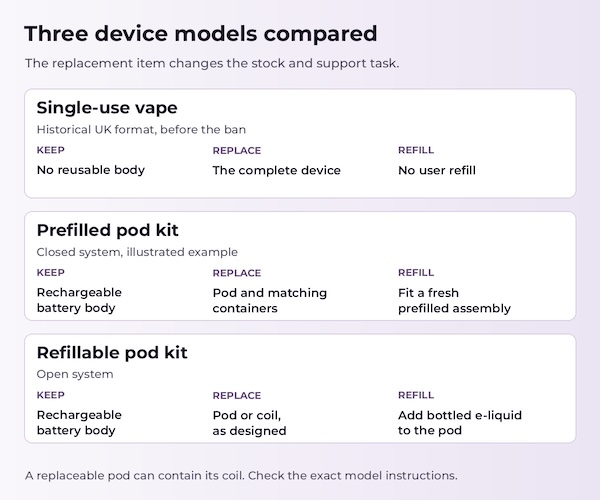
The historical single-use format replaced the complete device. Reusable formats retain the battery body, but differ in how the liquid and coil are renewed.
| Device model | What the customer keeps | What the customer replaces | What the customer refills |
|---|---|---|---|
| Single-use vape, historical UK format | No reusable body | The complete device | No user refill |
| Prefilled pod kit, illustrated example | Rechargeable battery body | Pod and matching containers | Fit a fresh prefilled assembly |
| Refillable pod kit, open system | Rechargeable battery body | Pod or coil, as designed | Add bottled e-liquid to the pod |
The prefilled column describes the illustrated system. Other prefilled kits may use a pod without separate supply containers. With open systems, check whether the coil is built into the replacement pod or is a separate part. Those differences should survive the journey from supplier specification to shelf label.
Stock the replacement range as carefully as the kit range
I would start a buying sheet with the relationship between the device and its consumable. Give each a separate stock code, then record the exact compatibility, pack contents, nicotine strength, flavour wording, supplier and replenishment lead time. Keep kit sales and replacement-pack sales separate in reporting. Combining them hides whether the shop is supplying new devices or supporting existing ones.
For this model, a paired flavour pack has a different flavour in each container, while a single-flavour pack repeats the flavour. Record the full pairing as one stock item. Do not shorten it to the first flavour, or assume that the kit selector and replacement selector contain the same choices. Our published flavour guide specifically distinguishes those two lists.
Depth means availability within a flavour
In this model, flavour depth means holding enough of the relevant replacement pack to serve existing device owners. It is different from displaying many kit variants. If a working body stays with the customer, the next required item may be a consumable rather than another complete kit. That is a reason to allocate replenishment attention to pods, not a forecast of guaranteed repeat business.
Use actual demand over the supplier’s lead time, then add a buffer appropriate to the reliability of that supply. Review this by flavour and model. Record requests made while an item is unavailable; otherwise a stockout can look like weak demand in a sales-only report. Treat those requests as evidence to investigate, not as completed orders.
A useful weekly review would ask three questions: which working device families lack replacement cover, which flavours repeatedly run short, and which packs sit without demand? This connects the buying decision to customer support. Simply counting the total number of pod packs on the shelf cannot show whether they fit the devices your customers own.
Plan for slow stock and model changes
Before expanding a device family, ask what notice the supplier gives when consumables change or cease production. Record the distinction between a new flavour, a revised pack and a new connector. Do not merge two generations because their names look similar. Keep the old compatibility record available so staff can identify a customer’s existing device.
For slow stock, review the cause before ordering more kits to accompany it. The issue could be an unpopular pairing, a poorly described pack or a model with too few owners in your customer base. These are hypotheses to test against requests and sales, not reasons to presume a national trend. Review batches and dates as well as quantities, particularly during a regulatory transition.
Separate setup questions from failed components
Give returns a structured record: exact device, exact replacement pack, batch details, symptom and whether the problem began before or after changing the assembly. For a claimed dead-on-arrival item, first establish which component is being reported. A replacement pack without a battery cannot be tested as a complete device.
For an intact product, use the supplied instructions to check model match, transit-seal removal, assembly seating and preparation. Do not turn this into improvised disassembly or repeated testing of a damaged item. Keep uncertain or defective stock out of sale pending assessment, and agree an evidence process with the supplier. Use the record to identify what needs investigation rather than recording every problem as a faulty kit. A setup question, a defective consumable and a failed battery need different responses.
Make compatibility and setup easy to understand
On a product page, put the pack identity and compatible model near the name and contents. On a shelf card, place the equivalent information beside the kit and its replacements where local display rules permit. A customer should not need to infer whether the item includes a battery from its photograph or dimensions.
For our worked example, a factual reference card could say:
- Fits: Hayati Pro Ultra Plus 25000, also called Pro Ultra Plus 25K.
- Contains: one 2 ml prefilled pod with built-in dual mesh coil, two 10 ml containers and a manual.
- Requires: the matching rechargeable device; no battery is included.
- Operation: replace the prefilled assembly and follow the supplied setup instructions; do not add bottled e-liquid.
- Nicotine: check the pack marking; this listing specifies 20 mg/ml.
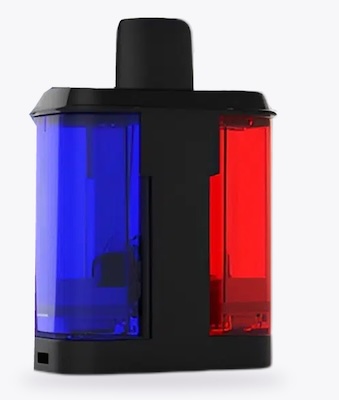
The replacement assembly from our gallery, shown without its retail carton. Its appearance should supplement the exact model and contents description, not replace them.
Our published support material addresses three separate tasks: identifying the model, fitting a replacement and charging the battery. I would preserve that separation in a shop’s staff notes. Otherwise a question about an empty pod can receive a charging answer, or a customer holding the wrong pack can receive unnecessary setup instructions.
Ask for the full model name before diagnosing fit. Then establish whether the person has a complete kit or only a replacement pack, and whether they are trying to replace the assembly or manually fill it. These questions are useful because each leads to a different instruction. Make those distinctions before asking the customer to open a replacement pack, particularly when compatibility is uncertain.
Keep photographs current when components change. Show the actual replacement assembly and state when internal parts are not visible, as the annotated figure does here. If the customer’s parts differ from the reference, check the supplied leaflet and supplier record before suggesting a procedure. A clear stop point is more useful than a confident guess based on another device.
Compliance: separate the UK rules from the US rules
UK product and supply requirements
The Tobacco and Related Products Regulations 2016, or TRPR, set the relevant consumer nicotine-product limits: a 2 ml tank limit, no more than 10 ml in a dedicated nicotine refill container and no more than 20 mg/ml nicotine. Multiple containers in a pack do not make their combined volume the tank’s capacity. Equally, correctly sized components alone do not prove that a complete product complies. 3
TPD means Tobacco Products Directive, the European directive behind these rules. For a UK stock check, use the applicable UK requirements and the Medicines and Healthcare products Regulatory Agency, or MHRA, guidance. MHRA administers the nicotine-product notification scheme. Check the exact product identity and publication status, plus the required packaging and labelling; do not treat a general supplier claim as confirmation for every variant. 4 5
The reusable-device test is separate. In England, Trading Standards, the local authority enforcement service, leads enforcement of the single-use ban. Retain evidence of the replacement arrangement and separately available consumables. These checks explain the system’s design; this article does not certify a particular batch or its notification status. UK vaping products are restricted to adults aged 18 and over. 1 6
Vaping Products Duty began on 1 October 2026 for vaping liquids manufactured in or imported into the UK from that date, subject to the duty-suspension rules. It applies regardless of nicotine content. HMRC allows qualifying older unstamped stock to be sold during the transition through 31 March 2027. From 1 April 2027, products within the retail scheme must carry a valid duty stamp. Record stock provenance and batch dates rather than treating every unstamped pack alike during the transition. 7 8
Section 15 of the Tobacco and Vapes Act 2026 took effect in England and Wales on 29 October 2026. It prohibits distributing relevant products without payment, or at substantial price reductions, where the promotional purpose or knowledge test is met. Keep customer education factual and review any proposed distribution arrangement against the applicable rules. 9
A separate position for US shops
UK availability is not US authorisation. The US Food and Drug Administration, or FDA, requires the relevant premarket authorisation before a new tobacco product can be lawfully marketed. A pending application does not itself permit sale. Check the exact product against FDA’s current information and verify applicable state and local requirements before stocking it. This UK example is not a recommendation to import or sell the illustrated product in the US. The US federal minimum sales age is 21. 10 11 12 16
What UK shops should prepare for next
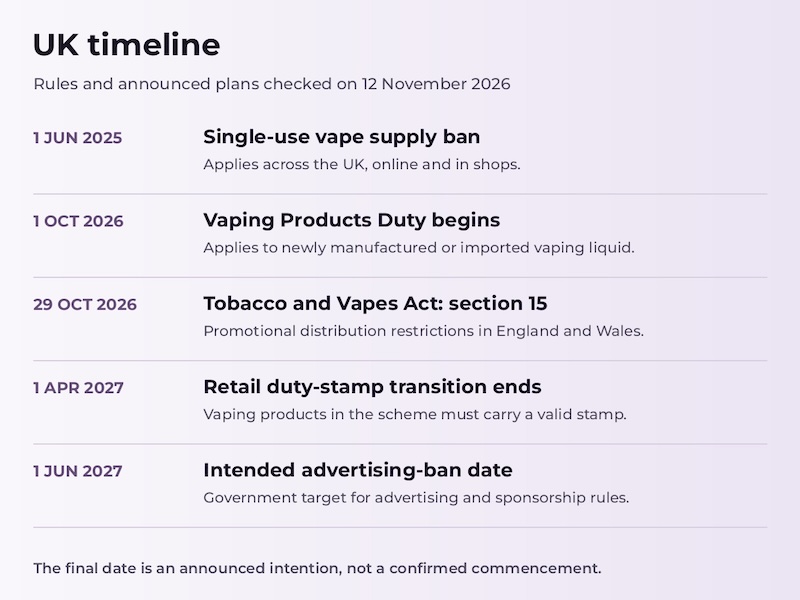
The duty-stamp deadline and the government’s intended advertising date have different legal statuses. Section 15 is identified here for England and Wales. Sources: 1, 7, 8, 9 and 13 below.
On 1 June 2026, the Department of Health and Social Care said it intended to bring the comprehensive advertising and sponsorship restrictions into effect on 1 June 2027. Its announcement distinguishes factual product information from promotional content. The stated date is an intention requiring commencement measures, so it should be monitored rather than silently treated as a settled deadline. 13
The Act also gives powers to regulate packaging, product features, contents and flavours. A government consultation, updated on 7 September 2026 and closed on 2 October 2026, considered packaging, flavour descriptions, appearance and displays. Those proposals are not evidence that a particular flavour or pack design has already been prohibited. 14 15
My practical priority would be to keep product identity, compatibility and instructions accurate enough to stand independently of changing presentation rules. Maintain a dated record of what each kit needs, which replacement pack supplies it and what evidence supports the description. That is work a shop can use today, whether its next change concerns a supplier, a product generation or a regulation.
FAQ
Does a rechargeable battery make a vape reusable under UK rules?
No. The liquid container must also be refillable or replaceable, and any coil must be replaceable, including within a replacement pod. The relevant replacement items must be separately available to the user.
Can a customer add bottled liquid to this Hayati pack?
Our product instructions specify replacement of the sealed prefilled assembly. They do not describe an open pod for bottled e-liquid, so staff should explain the replacement procedure and refer to the supplied leaflet.
Do all Hayati pods fit the Pro Ultra Plus 25000?
No. Match the full supported model name, not just the brand. The listed Pro Ultra Plus 25000 pack does not fit the original Pro Ultra 15000 or the Pro Max Plus.
How many replacement packs should a shop hold for each kit?
There is no verified universal ratio. Use the shop’s actual replacement demand, requests during stockouts and supplier lead times, reviewing each flavour and model separately rather than calculating orders from puff ratings.
Is an unstamped UK pack automatically unsaleable in November 2026?
Not necessarily. HMRC’s transition allows qualifying stock manufactured or imported before 1 October 2026 to continue through 31 March 2027; establish its history and check the applicable conditions. Products in the retail scheme require a valid duty stamp from 1 April 2027.
Can a US retailer stock the example because it is sold in the UK?
No. The retailer must establish the relevant FDA marketing authorisation and compliance with applicable state and local rules. The category’s stock-management lessons do not transfer a product’s legal status between countries.
Sources
Primary regulatory sources checked on 12 November 2026. Product descriptions and compatibility statements are from our catalogue and published reference guides; the replacement-pack record is cited where its contents are explained.
- GOV.UK: Single-use vapes ban, information for businesses.
- Environmental Protection (Single-use Vapes) (England) Regulations 2024, regulation 3.
- Tobacco and Related Products Regulations 2016, regulation 36.
- MHRA: E-cigarettes, regulations for consumer products.
- Tobacco and Related Products Regulations 2016, explanatory note.
- GOV.UK: Selling vaping and nicotine products.
- HMRC: New Vaping Products Duty comes into effect, 1 October 2026.
- HMRC: Handling wholesale or retail vaping products in the UK.
- Tobacco and Vapes Act 2026, section 15 and commencement annotation.
- FDA: Advisory and enforcement actions for unauthorised tobacco products.
- FDA: Searchable Tobacco Products Database, additional information.
- FDA: Tobacco 21.
- DHSC: Intended advertising and sponsorship restrictions, statement of 1 June 2026.
- Tobacco and Vapes Act 2026, explanatory notes on product requirements.
- GOV.UK: Tobacco and vapes, packaging, appearance and display consultation.
- FDA: Selling tobacco products in retail stores, including state and local requirements.
About the author
Reza runs Vape Forest, an online vape shop in London that sells to UK adults. He writes practical reference guides for its customers.
Jason Artman is the founder of eCigOne.com, where he helps vape and alternative nicotine brands grow through SEO and digital marketing. Jason's work has been featured in major media and cited in peer-reviewed research. He has helped to drive growth for well-known vape brands such as JUUL, NJOY, VaporFi, South Beach Smoke and V2 Cigs.
0 Comments